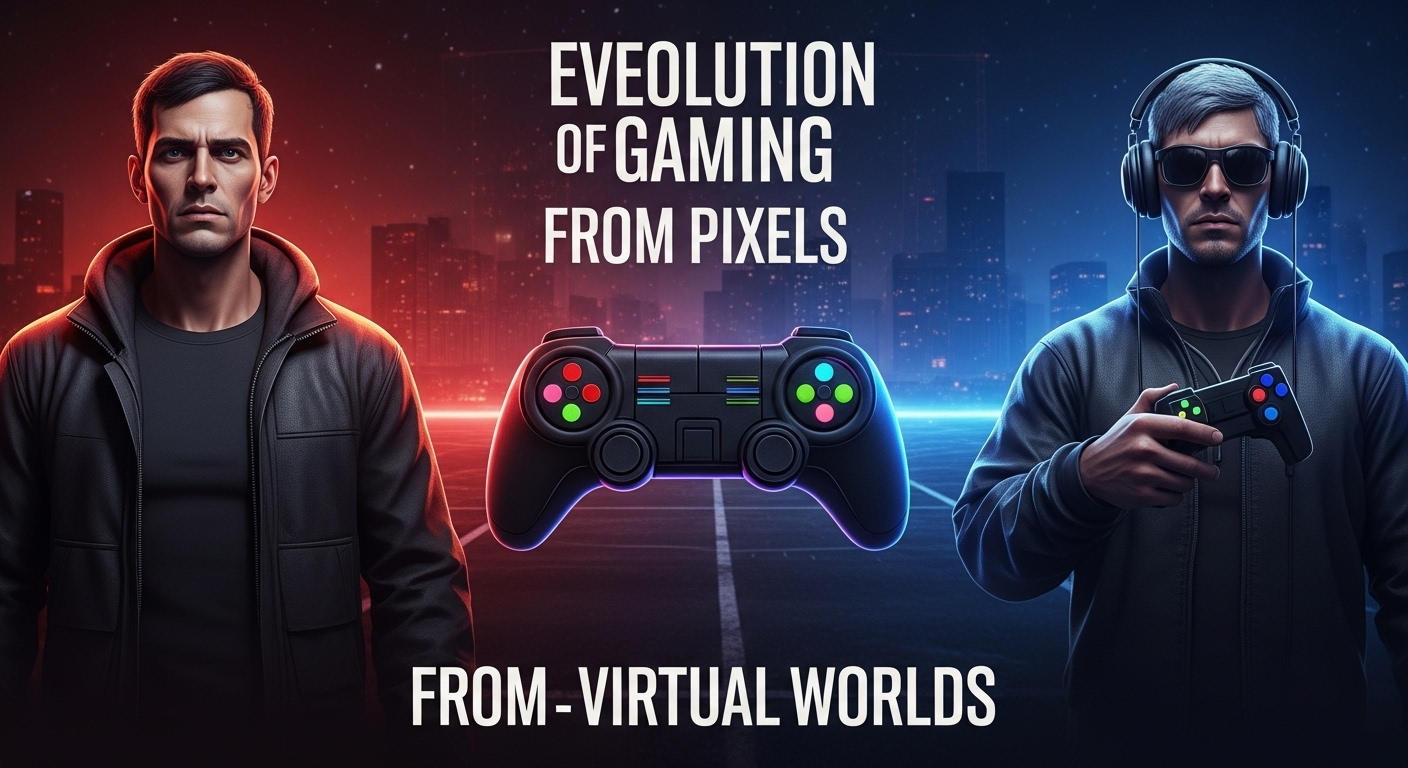
Gaming has evolved from a niche hobby into a global cultural and economic powerhouse that shapes how we play, connect, and even think. From the simple pixelated screens of the 1970s to the immersive virtual worlds of today, gaming has transcended boundaries of age, geography, and technology. It has become more than just a pastime—it’s an art form, a sport, and a means of storytelling that rivals even the most celebrated films and books. Understanding the journey of gaming reveals how far humanity’s creativity and technology have come, and where they might take us next.
The Humble Beginnings of Gaming
The story of gaming begins long before modern computers existed. Early experiments in electronic entertainment were simple and experimental. In the 1950s, computer scientists began creating basic games like “Tennis for Two” and “Spacewar!”—rudimentary simulations that ran on massive machines meant for research. These early games were not created for profit but out of curiosity and innovation. They represented a spark of imagination—a glimpse into what computers could do beyond calculation.
Then came the 1970s, when gaming truly started to take shape as a commercial and cultural force. The release of “Pong” by Atari marked a defining moment. It was simple—a virtual table tennis game with two paddles and a bouncing dot—but it captured the public’s imagination. Suddenly, people were lining up in arcades to experience this new form of entertainment. The success of “Pong” laid the foundation for an entire industry.
The Rise of the Arcade Era
The late 1970s and early 1980s were dominated by the arcade boom. Neon-lit rooms filled with beeping machines became social gathering places for millions of young players. Classics like “Pac-Man,” “Donkey Kong,” and “Space Invaders” transformed gaming into a mainstream activity. Each new release pushed the limits of what was possible with simple graphics and sound, creating characters and worlds that would become iconic.
Arcades were more than entertainment—they were cultural landmarks. Teenagers gathered after school, friendships formed over high scores, and rivalries emerged at the leaderboards. The thrill of inserting a coin and competing for glory created a sense of community that would carry over into future gaming generations.
But this golden era wasn’t just about fun. It was about innovation. Developers learned how to balance challenge and reward, how to design experiences that kept players engaged, and how to tell stories using only a few pixels. It was the birth of game design as a craft.
The Home Console Revolution
As technology advanced, gaming began to leave the arcade and enter the home. In the late 1970s and early 1980s, consoles like the Atari 2600 brought gaming into living rooms. For the first time, families could play together without leaving the house. The idea that entertainment could be interactive was revolutionary.
However, this early wave of home consoles also brought challenges. The market became flooded with low-quality games, leading to the infamous video game crash of 1983. Many thought gaming was a passing fad. But from the ashes of that crash, a new giant emerged—Nintendo.
The Nintendo Entertainment System (NES), released in the mid-1980s, revived the industry. With games like “Super Mario Bros.,” “The Legend of Zelda,” and “Metroid,” Nintendo set new standards for gameplay, storytelling, and character design. These weren’t just games—they were experiences that stayed with players long after they turned off the console. Nintendo’s focus on quality, creativity, and accessibility helped rebuild consumer trust and defined what gaming could be.
The 16-Bit Era and the Rise of Competition
As the 1990s dawned, gaming entered what many call its golden age. The 16-bit era introduced consoles like the Super Nintendo and Sega Genesis, which delivered colorful worlds, rich soundtracks, and deeper gameplay. Rivalries between companies created innovation at an unprecedented pace. The battle between Mario and Sonic became legendary, driving both Nintendo and Sega to push the limits of their hardware.
This period also marked the beginning of gaming franchises that continue to dominate today. “Final Fantasy,” “Street Fighter,” and “Mortal Kombat” became household names. Genres diversified—platformers, role-playing games, fighting games, and shooters all found their devoted fans. The narrative power of games began to grow, with titles like “Chrono Trigger” and “The Legend of Zelda: A Link to the Past” offering emotional and cinematic storytelling that rivaled films.
The Move to 3D and the Birth of Modern Gaming
The mid-1990s saw one of the most significant technological leaps in gaming history: the transition from 2D to 3D. The PlayStation, Nintendo 64, and later the Sega Dreamcast opened new frontiers of creativity. For the first time, players could explore fully realized worlds, not just side-scrolling levels.
Games like “Super Mario 64” and “The Legend of Zelda: Ocarina of Time” redefined what it meant to interact with a virtual environment. “Final Fantasy VII” brought cinematic storytelling and emotional depth to gaming, while “Metal Gear Solid” introduced stealth mechanics and complex narratives. The PlayStation became a cultural icon, bridging the gap between niche gamers and mainstream audiences.
This was also when gaming began to be recognized as an art form. Developers experimented with mood, atmosphere, and character development. Games were no longer just about scoring points—they were about experiencing worlds and emotions.
The Online Revolution
The late 1990s and early 2000s introduced another major shift: the rise of online gaming. With faster internet connections becoming more common, players could now connect with others across the globe. Multiplayer gaming became a phenomenon, transforming how people interacted.
Early online hits like “Quake” and “Diablo II” laid the groundwork for modern multiplayer design. Then came “World of Warcraft,” which redefined what online games could be. Millions of players adventured together in massive virtual worlds, forming guilds, trading items, and building entire digital societies. Gaming became a shared experience on a scale never before seen.
Consoles joined the online revolution as well. Services like Xbox Live and PlayStation Network introduced voice chat, downloadable content, and online leaderboards. Gaming became more social, more competitive, and more connected than ever.
The Age of High Definition and Storytelling Mastery
The mid-2000s to early 2010s marked a new era of gaming sophistication. With consoles like the Xbox 360, PlayStation 3, and later the PlayStation 4 and Xbox One, developers gained the power to create photorealistic visuals and complex physics. This technological leap allowed games to tell stories with cinematic quality.
Titles like “The Last of Us,” “Red Dead Redemption,” and “Bioshock” pushed the boundaries of narrative and emotion. Players were no longer just participants—they were living the story. These games explored mature themes like morality, loss, and survival, proving that gaming could be as artistically and emotionally impactful as film or literature.
This era also saw the rise of the indie game movement. With digital distribution platforms like Steam, smaller studios could reach global audiences without massive budgets. Games like “Braid,” “Undertale,” and “Celeste” showed that creativity and heart could triumph over graphics and scale. Indie developers brought fresh ideas and emotional storytelling to the forefront, reminding players of the power of innovation.
The Emergence of Esports and Gaming Culture
As online gaming grew, so did competitive gaming. What began as friendly matches evolved into professional esports, where skilled players compete for fame and fortune. Games like “League of Legends,” “Counter-Strike,” and “Dota 2” became international phenomena, with tournaments watched by millions.
Esports transformed gaming into a spectator sport. Stadiums filled with fans cheering for their favorite teams, while streaming platforms allowed anyone to broadcast their gameplay to the world. Professional players became celebrities, earning sponsorships and building fanbases.
This rise of esports also helped legitimize gaming as a serious pursuit. Universities began offering scholarships for esports athletes, and major companies invested in teams and events. What was once considered a niche hobby had become a billion-dollar global industry.
The Mobile Gaming Explosion
In the 2010s, mobile devices revolutionized how and where people played games. With the rise of smartphones, gaming became accessible to everyone, everywhere. Titles like “Angry Birds,” “Candy Crush,” and “Clash of Clans” reached audiences far beyond traditional gamers.
Mobile gaming’s success was driven by its simplicity and convenience. Anyone could download a game and start playing instantly. It democratized gaming, reaching demographics that consoles and PCs often missed. For many people, their first gaming experience came not from a console but from a mobile phone.
At the same time, mobile platforms evolved to support more complex and graphically impressive games. “Genshin Impact” and “PUBG Mobile” demonstrated that mobile gaming could deliver console-quality experiences. Today, mobile gaming dominates global revenue, proving that accessibility is as important as innovation.
Virtual Reality, Augmented Reality, and the Future of Immersion
As gaming hardware continues to evolve, the line between reality and virtuality grows thinner. Virtual reality (VR) and augmented reality (AR) are pushing the boundaries of immersion. VR headsets like the Oculus Quest and PlayStation VR allow players to step inside the game world itself, while AR games like “Pokémon GO” blend digital experiences with the real world.
These technologies are not just novelties—they represent the next evolution of gaming. VR brings unparalleled presence and interactivity, letting players physically move, look around, and engage with environments. AR adds a layer of magic to everyday life, transforming streets and parks into playgrounds.
While VR and AR are still developing, they hint at a future where gaming is not confined to screens but integrated into our lives. Imagine games that respond to your emotions, learn your habits, and adapt in real time. The potential is limitless.
The Social Impact of Gaming
Beyond entertainment, gaming has had a profound impact on society. It fosters creativity, teamwork, and problem-solving skills. Many modern games encourage cooperation and communication, teaching players how to collaborate effectively. Educational games help students learn through interaction, while simulations train professionals in fields like medicine, aviation, and engineering.
Gaming also serves as a form of social connection. Online communities give people a sense of belonging, especially for those who may struggle to connect in traditional settings. For many, gaming friendships are as meaningful as those formed offline. During global crises, such as the COVID-19 pandemic, games provided a safe and joyful way for people to stay connected.
However, gaming’s influence isn’t without challenges. Issues like addiction, toxicity, and exclusion have sparked important conversations about responsible gaming. The industry is gradually addressing these concerns, emphasizing moderation, inclusivity, and mental well-being. As gaming continues to mature, so too does the conversation around how to enjoy it healthily.
Gaming as Art and Storytelling
Modern gaming has proven itself as one of the most powerful storytelling mediums of our time. Games like “Journey,” “God of War,” and “Hollow Knight” blend art, music, and interactivity to create emotional journeys. Unlike passive media, games invite players to participate in the story, to make choices that shape outcomes, and to feel the consequences of those choices.
This interactivity makes gaming uniquely immersive. When players step into the shoes of a character, they experience empathy in a way that few other mediums can offer. They are not just witnessing the story—they are living it.
Gaming also provides a platform for diverse voices. Independent creators are telling stories that reflect a wide range of cultures, identities, and experiences. This diversity enriches the medium, allowing players to see the world through different perspectives.
The Future of Gaming: Boundless Possibilities
As technology continues to advance, the future of gaming looks limitless. Artificial intelligence will enable smarter and more adaptive worlds. Cloud gaming will allow people to play high-quality titles without expensive hardware. Procedural generation and machine learning will create experiences that evolve uniquely for each player.
Gaming is also merging with other forms of media. Interactive films, virtual concerts, and digital fashion are becoming part of the gaming ecosystem. The concept of the metaverse—a shared, persistent virtual space—is beginning to take shape, blurring the lines between game, social platform, and reality.
But beyond technology, the heart of gaming will always remain the same: the human desire to play, explore, and connect. From the earliest pixels to today’s hyper-realistic worlds, gaming has always been about imagination. It gives us the power to become heroes, builders, and dreamers.
Conclusion: The Power of Play
Gaming has come a long way from its humble beginnings in labs and arcades. It has evolved into a global art form that entertains, educates, and unites people across cultures and generations. Whether it’s a simple mobile puzzle or an epic open-world adventure, every game offers a chance to experience something new.
As we look to the future, one thing is clear—gaming will continue to shape our world in ways we can’t yet imagine. It reflects who we are, what we value, and how we dream. It is more than a pastime; it is a living, evolving expression of human creativity.
From pixels to virtual worlds, gaming remains a celebration of imagination and innovation—a reminder that play is one of the most powerful forces in human history.
About the Author